
In the imports bracket, India was the United States' 11th largest supplier of goods in 2017

India's total gold imports in the current year can be estimated at 810 tonnes against 740 tonnes excluding replenishment of 50-60 tonnes.
Gold prices zoomed to set a new peak at Rs 9,950 per ten gram on the bullion market on Wednesday on hectic buying by stockists and jewellers, triggered by surging prices in the overseas markets.
Both gold and silver made a smart comeback and recovered by Rs 55 per 10 gram and Rs 100 per kilo, respectively, on the Bullion market in Mumbai on Wednesday on revival of heavy stockists' buying boosted by rise in the global prices.

The precious metal spurted by Rs 200 from Friday's level at scale a new peak of Rs 15,900 per 10 gram.
Correcting a serious anomaly in the value added tax structure, an official committee on Monday prevailed upon Delhi, Rajasthan, Uttar Pradesh and Gujarat to maintain uniform tax rates on bullion.
Gold prices crashed by another Rs 130 at Rs 7,335 per 10 gram on the bullion market today on sustained selling by stockists and speculators largely fueled by a weakening trend in Asian markets. \n
Gold prices are expected to slump by 5 per cent before the end of this month to $855 per ounce as leaders of G-20 nations agreed on Thursday that the International Monetary Fund should sell gold from its reserve to help stimulate the world economy.

The adverse impact on the margins of auto, consumer staples and consumer durables sectors will be counterbalanced by an earnings uptick in the metals, cement and oil & gas sectors.
India is at a greater risk than the other three BRIC (Brazil, Russia and China) economies in the event of a slowdown in the US economy, a study by global investment banking firm Goldman Sachs has said.
Gold prices crashed by Rs 115 per ten gram and silver plunged by Rs 375 per kilo in the bullion market in Mumbai on Tuesday due to heavy stockists' selling after steep fall in the international prices.
Gold prices surged Rs 175 to a record high of Rs 8,150 per ten gram on the bullion market on Monday on sustained buying by stockists induced by a unprecedented rise in its prices in overseas markets.
Subdued volumes notwithstanding, the bullion market displayed a firm trend as both the precious metals, silver and gold, zoomed to new heights on stockists and speculators buying.
Gold prices spurted on the bullion market on Wednesday on sustained buying by stockists influenced by a firming trend in international markets and set a new high at Rs 7,750 per ten gram.
British police ambushed the gang which raided a warehouse containing bullion and bank notes.
Gold prices on Thursday scaled to Rs 6,800 per ten gram, a level never seen before in the history of bullion market in New Delhi, as stockists indulged in brisk buying triggered by a firm international trend.
Delhi and Maharashtra may lower value added tax on bullion to 0.25 per cent as consensus on introducing uniform floor rate for precious metals seemed difficult to emerge at the empowered committee's meeting on Wednesday
Both the precious metals, gold and silver, ounce again broke all previous records and ended at all-time high of Rs 6,270 per 10 gram and Rs 9,605 per kilo, respectively on the bullion market in Mumbai on Monday.

Increase in gold imports pushed the country's trade deficit to a five-month high of $ 15.33 billion in April.

Investors will get the money directly in their demat accounts or through their brokers. They won't get physical delivery any more.
Traders in India, the world's largest gold consumer, were stocking up on the precious metal on Monday amid fears that a US-led war with Iraq was imminent and could push bullion prices higher, dealers said.\n\n\n\n
Indian buyers were on a gold buying spree during the July-September 2004 period despite the rising prices of the precious metal, said a World Gold Council report on Tuesday.
India, the world's largest gold consumer, is likely to resume import of the precious metal this week after a long lull, as global prices have fallen sharply amid signs the United States is unlikely to attack Iraq immediately.
There is good news and even better news for gold consumers - prices of the precious metal have fallen to a nine-month low of Rs 8,725 per ten grams right ahead of the marriage season and are set to dip further in the coming weeks.
Gold, worth crores of rupees, belonging to the State Bank of India was reported missing three days ago during transit from Mumbai to Delhi.
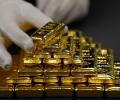
The government on Tuesday said it is fully prepared to implement mandatory hallmarking of gold jewellery and artefacts from June 1, 2021. Gold hallmarking is a purity certification of the precious metal and is voluntary in nature at present. The Centre, in November 2019, had announced that hallmarking of gold jewellery and artefacts would be made mandatory across the country from January 15, 2021.
The precious metal gold peaked to 11 week high on the domestic markets Friday following higher international advices on weaker dollar.
After scaling record high peaks, both the precious metals -- silver and gold witnessed a free fall across the board in opening session today on brisk selling by stockists triggered by weak overseas trend.

A dedicated physical gold exchange could lead to standard gold pricing in India.

Traders said sustained selling by stockists against sluggish demand and weakening global trend mainly kept pressure on precious metals.

Silver has a dual role - 60 per cent of the total silver produced is used for industrial purposes in the electrical & electronics segment and photovoltaic demand mostly for solar panels.

Irrespective of the global movement, gold prices in India are nearing the level of Rs 34,000 per 10 grams in the physical markets.

Traders said restricted buying from jewellers and retailers mainly kept precious metals at previous levels.

Traders said increased buying by jewellers and retailers, triggered by upcoming festive season, led to recovery in prices of the precious metal.

Maruti's strategy for the SUV segment is to arrest the decline in customers for entry level hatchbacks.

The country's largest carmaker Maruti Suzuki India on Wednesday reported a 66 per cent decline in consolidated net profit at Rs 487 crore in the second quarter ended September 30, 2021, as production was affected by the ongoing semiconductor shortage. The rise in commodity prices also had an adverse impact on the company's earnings.

Traders said stockists buying for the ongoing marriage season mainly led the recovery in gold and silver prices.
 © 2026 Rediff.com - Advertise with us - Disclaimer - Privacy Policy - Sitemap - Feedback - About us - Terms of use - Grievances